Easy Piano Songs for Beginners
A beginner-friendly guide to choosing easy piano songs, with song ideas, difficulty levels, practice tips, and advice for adults and children.
Quick Answer
The best easy piano songs for beginners use a small group of notes, a slow or moderate tempo, simple rhythm, and repeated patterns. Good first choices include short traditional melodies, simple classical themes, and beginner arrangements with one-hand melody before adding an easy left hand. A song is beginner-friendly when you can practice it in small sections, count it steadily, and play it slowly without guessing every note.
What Makes A Piano Song Easy?
An easy piano song is not just a song you know. It is a song that matches your current piano skills.
Many beginners choose songs because they love them, then discover that the arrangement has fast notes, large jumps, complicated rhythm, or a busy left hand. That does not mean the song is impossible forever. It means that version may not be the right first version.
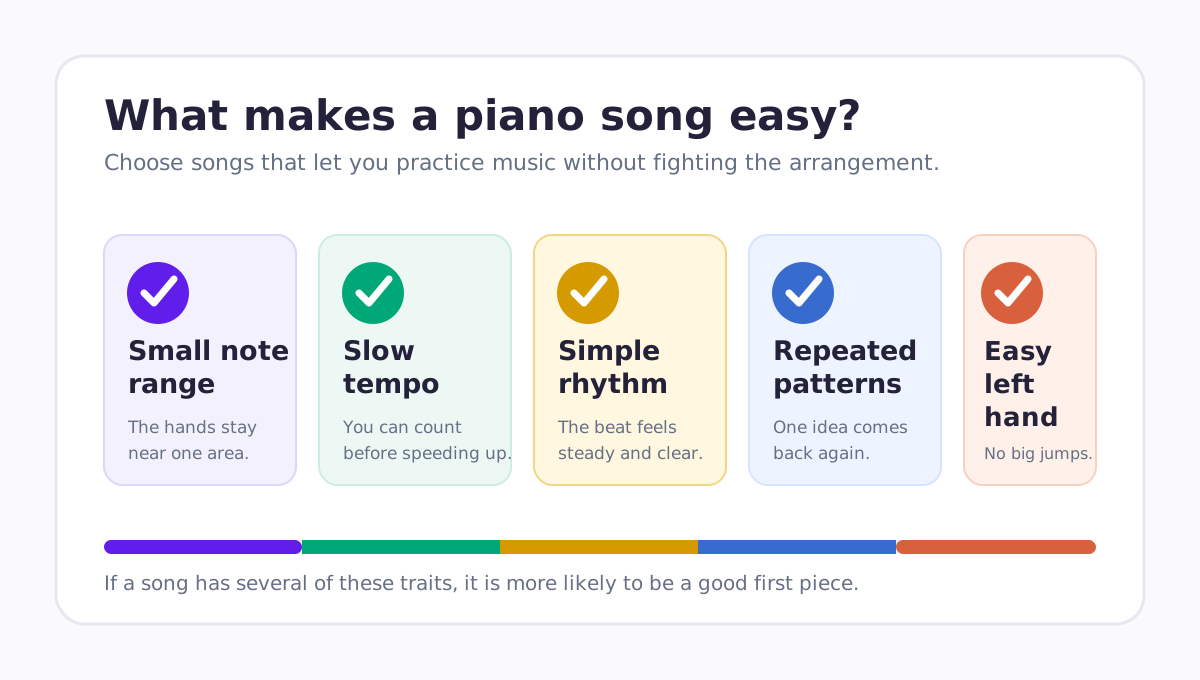
For a beginner, a good song usually has:
- a small note range
- mostly step-by-step movement
- repeated patterns
- a steady beat
- a slow or moderate tempo
- simple rhythms
- an easy left hand
- short sections that can be practiced separately
Use these signs before choosing a piece.
Good First Piano Songs For Beginners
These song ideas are common beginner choices because they can be learned in simple arrangements. The exact difficulty depends on the version, so look for beginner or very easy piano arrangements.
- Ode to Joy: The rhythm repeats and the melody is familiar. Start with the right-hand melody.
- Twinkle Twinkle Little Star: The range is small and the phrase structure is clear. Start with one hand, then add simple bass notes.
- Mary Had a Little Lamb: The melody mostly moves step by step. Start with the right hand only.
- Jingle Bells: The rhythm is familiar and many notes repeat. Use a slow beginner arrangement.
- When the Saints Go Marching In: The melody uses repeated patterns. Start with the melody and simple left-hand notes.
- Frere Jacques: The phrases are short and repetitive. Start with a one-hand melody.
- Amazing Grace: The tempo is slow and the melody is singable. Use a simplified melody arrangement.
- Happy Birthday: The song is useful and familiar. Choose a very easy arrangement in C major.
You do not need to learn all of them. Pick one song that is short enough to finish and familiar enough that you can hear when something sounds wrong.
Start With One-Hand Songs
The easiest first piano songs are often right-hand melodies. This is not a shortcut or a failure. It is a normal first step.
A one-hand version lets you focus on:
- finding notes
- using the correct fingers
- counting rhythm
- playing without tension
- hearing the melody clearly
Once the melody feels steady, you can add a simple left-hand part. For example, the left hand might play one low note at the start of each measure. That is enough for a beginner. You do not need full chords immediately.
Easy Songs By Beginner Level
Different beginners need different kinds of easy songs. A song that is easy after three months may be frustrating in the first week.
- First week: Choose 3- to 5-note melodies. Avoid big jumps and both-hand arrangements.
- First month: Choose familiar melodies in C position. Avoid fast tempos and music with many sharps or flats.
- 2-3 months: Choose short songs with simple left-hand notes. Avoid busy accompaniment patterns.
- 3-6 months: Choose easy two-hand arrangements. Avoid full pop or classical sheet music unless it is simplified.
- 6+ months: Choose longer beginner pieces with repeated chords. Avoid arrangements marked intermediate until the basics feel steady.
If a song feels too hard, choose an easier arrangement before abandoning the song. The same song can exist in many levels.
How To Know If An Arrangement Is Too Hard
A beginner arrangement may be too difficult if:
- both hands move constantly
- the left hand has large jumps
- the notes go far above or below the middle of the keyboard
- the rhythm is hard to count
- there are many sharps or flats
- you cannot play two measures slowly after several tries
- you restart from the beginning after every mistake
One difficult sign is not always a problem. Several difficult signs together usually mean the piece is too hard for now.
The best beginner song should stretch you a little, not stop you every few seconds.
How To Practice An Easy Piano Song
Do not practice the whole song from the beginning every time. That usually makes the beginning stronger and leaves the hard section weak.
Use this process instead:
- Listen to the song or sing the melody silently.
- Find the starting note.
- Practice the right hand alone.
- Clap or count the rhythm.
- Practice two measures slowly.
- Repeat the difficult part before connecting it to the beginning.
- Add the left hand only when the melody is stable.
Short sections are more useful than long run-throughs. Two measures practiced carefully can improve a song more than five full play-throughs with the same mistakes.
A Simple Practice Plan For One Song
Here is a realistic five-day plan for a beginner song.
- Day 1: Learn the first phrase with the right hand slowly.
- Day 2: Learn the second phrase and focus on notes and rhythm.
- Day 3: Connect both phrases, stopping at mistakes instead of restarting from the beginning.
- Day 4: Add a simple left hand with one bass note or chord at a time.
- Day 5: Play the full song slowly with steady tempo and relaxed hands.
This plan can take more than five days. That is fine. The point is to practice in steps instead of trying to force the whole song at once.
For a broader daily structure, see 15-Minute Piano Practice Routine for Beginners.
Should Beginners Learn Classical, Pop, Or Children’s Songs?
All three can work if the arrangement is simple enough.
Classical themes can be useful because many beginner versions are designed for piano learning. Traditional and children’s songs can be useful because the melodies are familiar and short. Pop songs can be motivating, but many original arrangements are too difficult for early beginners.
The style matters less than the arrangement. A simple version of a familiar song is better than an impressive version that you cannot practice successfully.
Easy Songs For Adult Beginners
Adult beginners sometimes avoid very simple songs because they feel childish. That is understandable, but simple music is not only for children.
An adult beginner can use easy songs to build:
- note recognition
- rhythm control
- hand comfort
- confidence
- steady practice habits
If a children’s melody feels unmotivating, choose a simple classical theme, a hymn, a folk tune, or a very easy arrangement of a favorite song. The goal is not to prove your musical taste. The goal is to learn piano movement in a way your hands can actually repeat.
Easy Songs For Children
Children usually do best with songs they can recognize, sing, or connect to a small goal.
Good choices are:
- short songs
- repeated melodies
- songs with clear rhythm
- songs that use a small group of notes
- songs that can be finished in one or two lines
Parents can help by keeping the task specific. Instead of saying “practice the song,” say:
- “Play the first line three times slowly.”
- “Find the starting note.”
- “Clap the rhythm before playing.”
- “Show me the part that got easier.”
This makes practice more concrete and less frustrating.
Should You Use Letter Notes?
Letter notes can help at the very beginning, especially when a learner is still finding the keys. But they should not become the only way to play.
If you use letter notes, use them as a bridge:
Helpful uses include:
- marking the first note
- checking note names
- learning the keyboard layout
- building early confidence
Risky uses include:
- labeling every note forever
- ignoring rhythm and finger movement
- avoiding sheet music completely
- guessing instead of reading patterns
Try to connect letter names to the keyboard pattern. The goal is to recognize notes faster, not to depend on labels permanently.
If note names still feel confusing, review Piano Notes for Beginners.
Common Mistakes With Beginner Songs
The most common mistake is choosing a song that is too hard because it sounds impressive.
Other common mistakes include:
- trying to play at full speed too soon
- ignoring rhythm
- practicing only the beginning
- adding the left hand before the melody is stable
- switching songs before finishing a small goal
- assuming a familiar song is automatically easy
Slow practice is not a sign that you are doing badly. Slow practice is how beginners teach the hands where to go.
How Many Songs Should A Beginner Learn?
At the start, it is better to learn a few songs well than to start many songs and finish none.
A good early goal is:
- one very easy song you can finish
- one song you are currently learning
- one favorite song for motivation
This gives you variety without scattering your attention. As your reading, rhythm, and coordination improve, you can add more songs.
Practicing Easy Piano Songs With tonestro
tonestro helps piano beginners practice easy songs with more structure than simply playing from the beginning over and over. You can choose beginner-friendly songs, practice slowly, repeat short sections, and use feedback to make notes, rhythm, and timing more reliable.
The beginner songs in this guide fit naturally into that kind of practice. Start with the easiest arrangement, work on one small section at a time, and treat each repetition as a chance to make the song steadier.
For beginners, the goal is not only to finish a song. The goal is to learn how to practice songs in a way that builds note reading, rhythm, hand coordination, and confidence.
Related Reading
- How to Learn Piano for Beginners
- Piano Notes for Beginners
- 15-Minute Piano Practice Routine for Beginners
- How Long Does It Take to Learn Piano?
FAQ
What is the easiest song to play on piano?
The easiest piano songs are short melodies with a small note range and simple rhythm. Many beginners start with songs like Mary Had a Little Lamb, Twinkle Twinkle Little Star, or very easy versions of Ode to Joy.
What piano song should I learn first?
Choose a song you recognize, but make sure the arrangement is very easy. A right-hand melody in C position is usually a better first choice than a full two-hand arrangement.
Can beginners learn pop songs on piano?
Yes, but beginners should use simplified arrangements. Original pop piano parts often include syncopated rhythm, fast chord changes, or wide left-hand movement that may be too difficult at first.
Should I learn songs or exercises first?
Beginners should use both. Songs keep practice musical, while short exercises help with notes, rhythm, and finger control. A good routine includes a little of each.
How long does it take to learn an easy piano song?
Some very easy songs can be learned in a few practice sessions. A longer beginner arrangement may take several weeks, depending on the learner’s practice routine and current skills.
Are children’s songs useful for adult piano beginners?
Yes. Simple songs can help adult beginners build coordination, note reading, and rhythm. Adults can also choose folk tunes, classical themes, hymns, or simplified favorite songs if children’s songs feel unmotivating.
Last updated